

By Raw Reporter’s International Affairs Correspondent
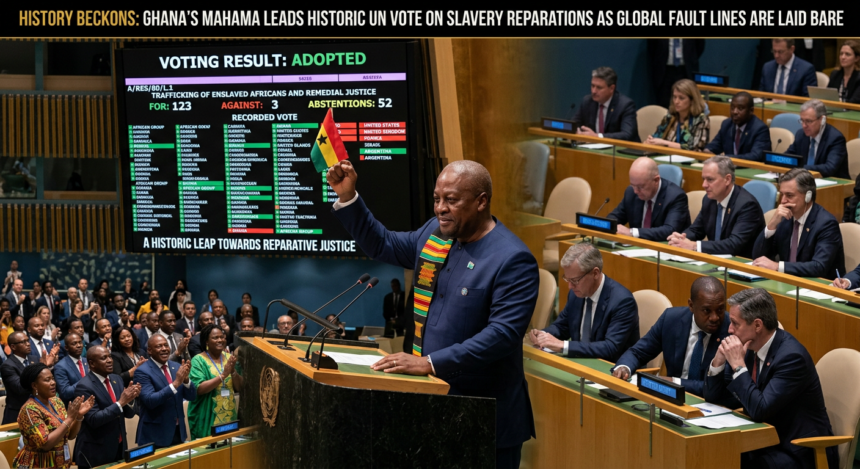
The United Nations General Assembly vote on March 25, 2026, marks a defining moment in the global conversation on historical justice. Spearheaded by Ghana’s President John Dramani Mahama, the resolution declaring the transatlantic slave trade the “gravest crime against humanity” and calling for reparations has not only revived a long-standing moral debate but also revealed deep geopolitical divisions within the international system.
This article examines the intellectual and political foundations of Mahama’s UN speech, the structure and outcome of the vote, and what the voting pattern reveals about the evolving global order.
Mahama’s Speech: From Historical Memory to Moral Imperative
President Mahama’s address at the UN General Assembly did not emerge in isolation. It was the culmination of a sustained diplomatic and rhetorical campaign positioning Africa—and Ghana in particular—as a leading voice in the global reparations’ movement.
At the core of his speech was a reframing of history. Mahama argued that the transatlantic slave trade was not merely a tragic episode, but a foundational system that shaped modern global inequalities. He described slavery as a “global economic and social order… built on lies, and enforced by violence,” underscoring its systemic and enduring consequences.
This framing served three strategic purposes:
- Moral elevation of the issue – By defining slavery as the gravest crime against humanity, the speech placed reparations within the realm of universal justice rather than regional grievance.
- Historical continuity – Mahama linked past injustices to present inequalities, arguing that contemporary disparities in wealth, race, and development are rooted in centuries of exploitation.
- Political mobilization – The speech positioned Africa and the diaspora as agents of change, not passive victims, calling for “concrete actions” rather than symbolic acknowledgment.
His rhetoric also drew on a broader narrative articulated in earlier UN addresses, where he emphasized Africa’s marginal role in the formation of global institutions and its growing demographic and economic significance in the future world order.
In essence, Mahama transformed reparations from a historical claim into a forward-looking political agenda.
The Resolution: Scope and Significance
The resolution adopted by the General Assembly represents a major symbolic victory. It:
- Declares the transatlantic slave trade the “gravest crime against humanity.”
- Calls for reparatory justice, including dialogue, restitution, and systemic reform.
- Encourages the return of cultural artifacts and recognition of enduring racial inequalities.
While non-binding, the resolution carries significant normative weight. It builds upon earlier acknowledgments, such as the 2001 Durban Declaration, but goes further by explicitly linking historical recognition to calls for material and structural redress.
More importantly, it institutionalizes reparations as a legitimate subject of multilateral diplomacy.
The Vote: Numbers and Alignment
The voting outcome is as revealing as the resolution itself:
- In favor: 123 countries
- Against: 3 countries (United States, Israel, Argentina)
- Abstentions: 52 countries (including the United Kingdom and all European Union members)
At first glance, the overwhelming support suggests a global consensus. However, a closer examination reveals a more complex geopolitical landscape.
Analyzing the Voting Pattern
1. The Global South Coalition
The 123 votes in favor were largely driven by countries in Africa, the Caribbean, Latin America, and parts of Asia. This coalition reflects shared historical experiences of colonialism, slavery, and economic exploitation.
The alignment is not accidental. It is rooted in:
- Collective historical memory
- Shared developmental challenges
- Growing political coordination through blocs such as the African Union (AU) and CARICOM
This bloc represents what can be described as a “post-colonial consensus,” where historical injustice is increasingly framed as a central issue in global governance.
2. The Western Abstention Bloc
Perhaps the most striking feature of the vote is the large number of abstentions—52 countries, dominated by European states.
These nations did not oppose the resolution outright but expressed reservations. Their stated concerns included:
- Opposition to creating a “hierarchy of historical atrocities”
- Disagreement with the legal implications of reparations
- Fear of setting precedents for financial liability
This abstention strategy reflects a middle-ground diplomacy:
- Acknowledging the moral weight of slavery
- Avoiding commitment to reparations
In practical terms, abstention allowed these states to maintain moral credibility without incurring legal or financial obligations.
3. The Minority Opposition
Only three countries voted against the resolution: the United States, Israel, and Argentina.
The United States’ position was particularly significant. It argued that the resolution:
- Misapplies contemporary legal standards to historical events
- Implies a legal right to reparations that did not exist at the time
This stance reflects a broader concern among some Western powers about:
- Legal liability
- Domestic political implications
- Precedent-setting in international law
The small number of opposing votes suggests that outright rejection of the reparations narrative is increasingly untenable on the global stage.
Key Patterns and What They Reveal
Pattern 1: Moral Consensus vs Legal Resistance
There is near-universal agreement that slavery was morally reprehensible. However, consensus fractures when the discussion shifts to legal responsibility and compensation.
- Moral agreement → widespread
- Legal commitment → contested
This divergence explains the high number of abstentions.
Pattern 2: North–South Divide Reasserted
The vote highlights a clear geopolitical divide:
- Global South: Advocating for reparatory justice
- Global North: Hesitant, cautious, or resistant
This divide mirrors broader tensions in international relations, including debates over climate justice, trade inequality, and development financing.
Pattern 3: Rise of African Diplomatic Leadership
Ghana’s leadership, under Mahama, demonstrates a shift in African diplomacy from reactive to proactive.
By securing 123 votes, Ghana:
- Positioned itself as a norm entrepreneur
- Strengthened AU and diaspora alliances
- Elevated reparations to a central global issue
This reflects a broader trend of African states asserting greater influence in multilateral institutions.
Pattern 4: Strategic Abstention as Policy
The abstentions reveal a sophisticated diplomatic strategy:
- Avoid direct opposition (which could appear morally indefensible)
- Avoid endorsement (which could imply liability)
This “strategic ambiguity” may become a recurring feature in contentious global issues.
Implications for Global Politics
1. Reparations Enter the Mainstream
The resolution moves reparations from the margins of activism into the center of international diplomacy. Even without legal force, it establishes a framework for future negotiations.
2. Increased Pressure on Western Nations
The abstaining countries may face growing pressure to clarify their positions. As the Global South consolidates its stance, neutrality may become harder to sustain.
3. Institutional Momentum
With backing from major blocs such as the African Union and CARICOM, the issue is likely to remain on the UN agenda. The declaration of a “Decade of Reparations” further institutionalizes the movement.
4. Redefinition of Global Justice
The debate signals a broader shift in how justice is conceptualized in international relations:
- From state-centric responsibility
- To historical and structural accountability
Conclusion: A Divided Yet Transformative Moment
The UN vote on Mahama’s reparations resolution is both a breakthrough and a mirror. It reflects a world increasingly willing to confront historical injustices—but still deeply divided on how to address them.
The overwhelming support for the resolution demonstrates that the moral case for reparations has gained global traction. However, the pattern of abstentions and opposition reveals enduring resistance rooted in legal, financial, and political concerns.
Ultimately, the vote underscores a fundamental reality:
The question is no longer whether the legacy of slavery should be addressed, but how—and by whom.
Mahama’s speech and the subsequent resolution have shifted the conversation irreversibly. What remains uncertain is whether this moral momentum can translate into concrete action.
For now, the world stands at a crossroads—between acknowledgment and accountability