

By Dr. Raymond Kojo Agbadi | Special Health Correspondent
ACCRA, GHANA — Imagine paying more than half your monthly salary just to manage a condition your doctor says you should have caught years ago — if only you had known about it. That, for millions of Ghanaians, is not a hypothetical scenario. It is Tuesday morning at the hypertension clinic. And Wednesday. And every week after that.
Hypertension — or high blood pressure — may not be as dramatic as a motor accident on the Accra-Tema motorway, but it is quietly, methodically, and expensively killing Ghanaians and draining the country’s healthcare system. It is, as health professionals have aptly called it, the “Silent Killer” — and it has found Ghana to be very accommodating indeed.
The Numbers Are Alarming — And Embarrassingly Familiar
Let us start with the facts, delivered without sugarcoating.
In Ghana, 27% of adults have hypertension, and only 6% have achieved controlled blood pressure. More than 60% of people with hypertension in Ghana are yet to be screened, and roughly 80% are yet to be initiated on treatment. Let that sink in for a moment. Ghana has more undiagnosed hypertensive patients walking around than it has people who have their condition under control.
To make matters more urgent, the Western Regional Health Directorate recently launched a large-scale screening program targeting 66,000 residents following a concerning rise in hypertension prevalence, from 2.16% in 2023 to 3.19% in 2024. That is nearly a 50% jump in reported prevalence in just one year in a single region — and yet, the response is still scrambling to catch up.
The latest data indicates hypertension as Ghana’s fifth most common cause of outpatient morbidity, which has been attributed to high population growth, an increase in life expectancy, and lifestyle factors. Meanwhile, in 2017, hypertension was reported as the third leading cause of hospital admissions and the leading cause of morbidity and death in Ghana. We are, quite literally, running out of road.
Who Is at Risk? (Hint: Probably You)
If you think hypertension only affects the elderly man napping under a mango tree after eating too much waakye, think again. Researchers found that obesity, excessive alcohol consumption, physical inactivity, and poor diets were linked to the increased prevalence of hypertension in a review of population-based studies on hypertension in Ghana.
The high intake of salt, poor eating habits, sedentary lifestyles, and increased alcohol intake may have increased the prevalence of hypertension. Urbanization — with its late-night fast food, long commutes, and desk-bound jobs — has turbo-charged the risk for working-age Ghanaians living in cities like Accra, Kumasi, and Takoradi.
And perhaps most alarming of all: over two-thirds of participants with high blood pressure in a major screening campaign were unaware of their condition. You simply do not know you have it until something goes terribly wrong — a stroke, kidney failure, a heart attack — all of which are far more expensive, and potentially fatal, to treat.
A Healthcare System Under Siege
Ghana’s health system was already stretched before hypertension turned up with all of its complications. When not adequately managed, hypertension can increase the risk of stroke and cardiovascular diseases. More than 80% of countries in Sub-Saharan Africa are unable to offer a minimum of three physician visits per year for optimal blood pressure control, as recommended by the latest clinical guidelines.
The system’s structural weaknesses compound the crisis. The knowledge, skills, and competency of the health workforce in the management and treatment of cardiovascular diseases is suboptimal. Most health facilities do not have the required equipment for the management and treatment of these diseases, and the emergency and referral system in Ghana is less developed. Weak coordination between peripheral and lower-level health facilities further affects quality of patient care, leading to increased morbidities and mortalities across the country.
Hypertension is the single most preventable risk factor for cardiovascular disease in Ghana and Africa, primarily due to undetected, untreated, and undertreated cases. Population-based studies in Ghana have shown an increase in hypertension prevalence reaching epidemic proportions and its significant impact on stroke morbidity and mortality over the last four decades.
And what happens when hypertension is left uncontrolled? It opens the door to stroke — a condition that is devastating in every sense of the word. The increasing prevalence of stroke in Ghana is likely to put a huge pressure on the already weak healthcare system and threaten the viability of poorly funded public health and primary healthcare services. The increasing burden of stroke also has huge economic implications, especially given that nearly half of the stroke patients were below 65 years of age. The economic impact of stroke could be felt as both a cost to the country’s healthcare system and the loss of income and production of those affected either directly by the disease or indirectly as caregivers.
When “Pressure” Becomes a Financial Crisis
Here is where things get truly sobering — both for individuals and for Ghana’s economy.
Estimates show that the economic burden of hypertension in terms of treatment cost is roughly GH¢438.124 million, representing roughly 0.08% of the gross domestic product. That may sound modest as a percentage, but it represents an enormous drain on a healthcare budget already overstretched by communicable diseases, maternal health, and infrastructure deficits.
At the household level, the toll is catastrophic. The total average monthly cost per hypertensive patient — including both direct and indirect costs — was USD19.52, amounting to an estimated annual expenditure of USD234.29 per patient. This means that approximately 54% of a patient’s monthly income was spent on hypertension management per month.
More than half your monthly income — gone. Just to manage a condition that could have been largely prevented with better public education, dietary habits, and early detection.
At the 40% catastrophic health expenditure threshold, 49.14% of patients were found to incur catastrophic health expenditure. Nearly half of all hypertensive patients are essentially in a financial crisis every month — choosing between medication and food, between a doctor’s visit and a child’s school fee. Despite the implementation of social protection policies in Ghana, there is a high level of catastrophic health expenditure among hypertensive patients. Most hypertensive patients have a negative capacity to pay, which means patients in such households could be forced to borrow and sell assets to cover medical expenses, and are likely to fall into deeper poverty. The total economic cost of managing hypertension and comorbid conditions has been found to constitute about 45.24% of Ghana’s GDP per capita, highlighting the substantial financial burden on affected households. This is not just a health statistic. This is a poverty trap dressed in a white coat.
The Productivity Time Bomb
Beyond hospitals and household budgets, hypertension is quietly sabotaging Ghana’s workforce. Mortality due to stroke and ischemic heart disease increased by 10.6% and 14.6%, respectively, in Ghana between 2007 and 2017. In terms of risk factors that contributed to disabilities in the same period, the deaths and disabilities caused by high blood pressure increased by 17.0%.
Ghanaian hypertensive patients have reported the devastating impact on their work lives in their own words. Some participants said they had to change their work schedules, and others indicated that they absented themselves from work frequently because of the disease condition. This was said to have created friction between the participants and their supervisors.
The mean age of stroke patients in sub-Saharan Africa was found to be 59 years, highlighting the heavy economic toll stroke exerts by affecting a relatively young and productive population. These are not retirees. These are teachers, farmers, traders, engineers, and nurses — the backbone of Ghana’s economy. When they are incapacitated, the ripple effects reach far beyond the clinic walls.
What the SDGs and WHO Are Saying (And Whether Ghana Is Listening)
The global community has not been silent on this issue. Hypertension sits squarely within the framework of Sustainable Development Goal 3 (SDG 3): Good Health and Well-Being, which calls for the reduction of premature deaths from non-communicable diseases (NCDs) and the achievement of Universal Health Coverage (UHC).
Globally, in 2021, an estimated 18 million people under the age of 70 died from a non-communicable disease. This figure represents more than half of deaths among people in this age range. The risk of premature death from any of the four main NCDs — cardiovascular diseases, cancer, chronic respiratory diseases, and diabetes — has decreased since 2015, but despite increased awareness, the world is not on track to meet the target for the reduction of non-communicable diseases. Universal Health Coverage means that all people receive the quality health services they need when and where they need them, without suffering financial hardship. Achieving UHC is a key target of the SDGs, adopted in 2015 and reaffirmed by countries at the 2019 and 2023 United Nations General Assembly High-Level Meetings on UHC. Progress on UHC supports other health targets and SDGs, making it a central focus of national health reforms and a core priority for WHO.
The WHO has been emphatic. Improving hypertension prevention and control should be an integral part of every nation’s journey towards Universal Health Coverage. Not only can this potentially save countless lives, it also carries significant economic advantages and advances progress towards SDG targets.
In 2013, the World Health Organization set the goal to reduce the prevalence of hypertension by 25% by the year 2025, compared to 2010, as part of the Global Non-Communicable Disease Action Plan 2013–2020. Ghana has had over a decade to act on this goal. The results, unfortunately, remain underwhelming. The Ghanaian government has developed several health policies working towards achieving this goal, such as the NCD policy and the Universal Health Coverage roadmap. However, a recent review of these policies showed that these plans have low levels of integration of hypertension prevention and control across most health policies. Specifically, poor financial allocation, low task-sharing initiatives, and lack of involvement of public and patients in policymaking will hamper the efforts of reaching the WHO 2025 goals.
In other words, Ghana has made plans — very good-looking plans on paper. But plans alone do not lower anyone’s blood pressure.
The NHIS: A Good Idea With Some Serious Gaps
Ghana’s National Health Insurance Scheme (NHIS), established in 2003, was designed as the great equalizer — the promise that no Ghanaian should be turned away from healthcare due to inability to pay. The NHIS is financed through a 2.5% levy on goods and services, as well as a 2.5% deduction from formal sector workers’ contributions. The scheme aims to improve financial access to healthcare, including coverage for hypertension services in Ghana.
However, despite being enrolled on the NHIS, hypertensive patients face considerable economic burdens with high rates of catastrophic health expenditure. There is, therefore, an urgent need to improve access to affordable antihypertensive medications at NHIS-accredited health facilities and reduce geographic barriers to care, particularly transportation costs and time spent accessing services.
The government of Ghana needs to address the impoverishing out-of-pocket payments associated with hypertension-related complications, particularly chronic kidney disease treatment costs, which substantially exceed the average income levels in Ghana and are not covered by the NHIS benefit package.
The scheme is helpful, but for many Ghanaians managing hypertension and its complications, it barely scratches the surface of what they need financially. The NHIS needs not just expansion — it needs a revolution in its coverage of NCD-related services.
The Road Forward: What Must Be Done
Ghana is not short of solutions. It is short of urgency and implementation. Here is what experts, global bodies, and the evidence are prescribing:
1. Decentralize Screening to Communities
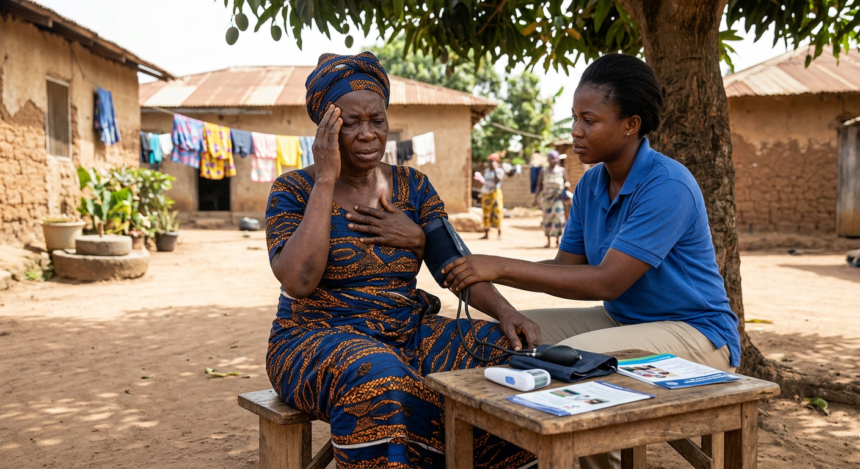
If Ghana is to screen and diagnose the estimated 60% of adults with hypertension, awareness campaigns and screening will need to be decentralized closer to the community, preferably at sites frequented by adults on a regular basis. Think churches, market squares, barbershops, mosques, and community centres — not just hospitals.
2. Strengthen Primary Healthcare for NCDs
The Ghanaian health system should emphasize the establishment of wellness centres and non-communicable disease clinics within all primary healthcare facilities. This strategic move will enhance the capacity of the healthcare system to deliver comprehensive and effective care for hypertension and its associated complications, thereby improving public health outcomes.
3. Fix the Financial Protection Gaps
Policies targeted at effectively managing NCDs should focus on strengthening a comprehensive and reliable National Health Insurance Scheme coverage for care of chronic conditions. No Ghanaian should lose their savings — or their home — because they have high blood pressure.
4. Political Will and Whole-of-Government Action
Ghana has sufficient information to prioritize the cardiovascular health of its people towards meeting the global target of a 25% reduction in the 2010 age-standardized prevalence of hypertension by the year 2025. Strong political commitment and concerted whole-of-government and whole-of-society actions are needed to implement best-buy interventions such as fiscal levers, salt reduction, health promotion, and promotion of physical activity.
5. Invest in Public Education
Most of the low awareness of hypertension has been attributed to the lack of rigorous educational programs. Ghana needs mass media campaigns, school curricula integrations, and community health worker programmes that put blood pressure awareness into every Ghanaian home.
6. Address Systemic Risk Factors
Future efforts should go beyond individual-level lifestyle advice and address system-level factors, such as neighborhood urban design and food environment, contributing to disparities in the hypertension burden. The fast-food culture, sedentary urban lifestyles, and ultra-processed foods flooding Ghana’s markets are public health emergencies in slow motion.
Conclusion: The Pressure Is On
Ghana is a nation of extraordinary resilience, ingenuity, and warmth. But resilience alone cannot shield its people from a condition that strikes without warning and costs without mercy. Hypertension is not just a medical problem — it is a development problem, an economic problem, and a governance problem.
The window to 2030, the SDG target year, is closing. Without accelerated and sustained progress, hard-won health gains risk being lost.
Every unchecked blood pressure reading is a potential stroke, a potential hospital admission, a potential family plunged into debt, and a potential productive life cut short. Undetected high blood pressure poses significant risks to vital organs and strains Ghana’s healthcare system.
The message is simple, even if the solution is complex: Measure it. Manage it. And as a nation — fund it.
Ghana cannot afford to let this silent killer keep winning. The pressure, quite literally, is on.
This article is based on peer-reviewed research, published studies, WHO reports, and Ghana Health Service data. It is intended for public education and policy awareness.
SIDEBAR: FAST FACTS
🔴 27% of Ghanaian adults have hypertension 🔴 Only 6% have controlled blood pressure 🔴 Over 60% of hypertensive Ghanaians are unscreened 🔴 Hypertension treatment costs represent approx. 0.08% of Ghana’s GDP 🔴 54% of a patient’s monthly income may go towards hypertension management 🔴 Nearly half of hypertensive patients in Ghana incur catastrophic health expenditure 🌍 WHO target: 25% reduction in hypertension prevalence by 2025 — Ghana is off track 🎯 SDG Target 3.4 & 3.8 — reducing NCD deaths and achieving Universal Health Coverage