

A Narrative on the NPP, NDC, and the Politics of Identity in Contemporary Ghana
Introduction
Few issues have crystallized the intersection of morality, governance, and electoral politics in Ghana quite like the debate surrounding LGBTQ+ rights. In a nation where Christian and Islamic values command enormous social and political influence, and where public sentiment remains overwhelmingly conservative on matters of sexual orientation and gender identity, the LGBTQ+ question has evolved from a peripheral social conversation into a potent political instrument. Both the ruling National Democratic Congress (NDC) and the principal opposition New Patriotic Party (NPP) have recognized, with varying degrees of calculation and conviction, that one’s positioning on this issue carries significant electoral consequences. Understanding how each party navigates this terrain reveals not only their strategic thinking but also the broader ideological fault lines that will shape Ghanaian politics in the years ahead.
The NPP’s Position: Moral Conservatism as Political Capital
Ideological Grounding
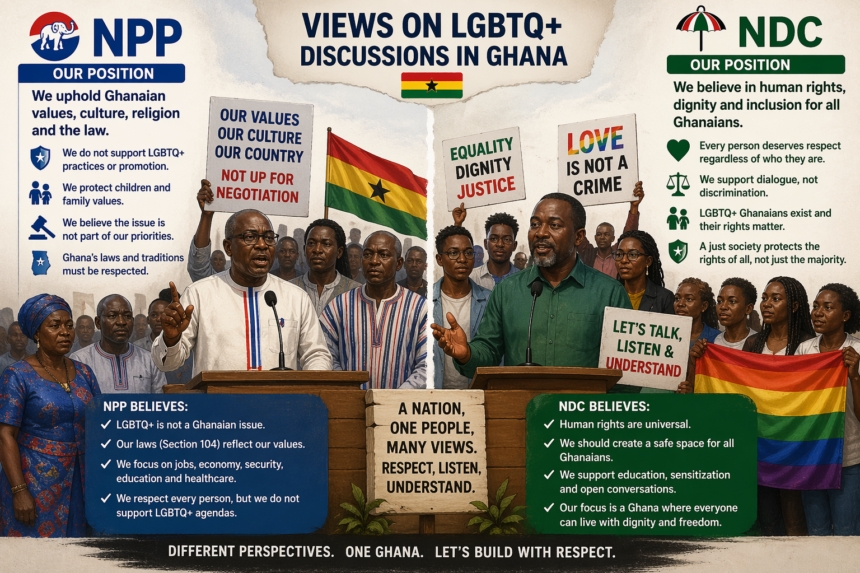
The New Patriotic Party, rooted in the Danquah-Busia-Dombo tradition, has historically presented itself as the defender of Ghanaian cultural values, constitutional governance, and social order. Within this philosophical framework, opposition to LGBTQ+ rights aligns naturally with the party’s conservative ideological orientation. Senior NPP figures have consistently maintained that the recognition or normalization of LGBTQ+ identities is fundamentally incompatible with Ghanaian cultural norms, constitutional provisions, and the religious values that anchor the lives of the majority of Ghanaians.
This position is not merely performative. Many within the NPP’s leadership and grassroots membership hold genuinely conservative views on matters of sexuality and family structure, viewing the institution of marriage and traditional gender roles as non-negotiable social pillars. The party’s base — spanning rural communities, religious associations, and market constituencies — broadly shares this worldview, making opposition to LGBTQ+ rights both an authentic expression of values and a strategically sound political posture.
The Anti-LGBTQ+ Bill as Political Leverage
One of the most significant legislative developments through which the NPP sought to define itself on this issue was the Human Sexual Rights and Family Values Bill, popularly known as the Anti-LGBTQ+ Bill. Though the Bill’s legislative journey was complex and traversed parliamentary sessions under both administrations, the NPP positioned itself as the ideological architect and moral champion of the legislation. Several NPP Members of Parliament were among its most vocal proponents, and the party seized every opportunity to associate itself with what it framed as a patriotic defense of Ghanaian values against what it characterized as Western cultural imperialism.
For the NPP, the strategic value of the Anti-LGBTQ+ Bill extends well beyond its substantive legal content. It serves as a powerful signaling mechanism — a declaration to the Ghanaian electorate, particularly religious communities, that the NPP stands as the unyielding guardian of traditional values at a time when external pressures from Western governments, international financial institutions, and human rights organizations are perceived as threatening Ghana’s cultural sovereignty.
Using LGBTQ+ Against the NDC: The Electoral Playbook
As the NPP recalibrates its political strategy following its 2024 electoral setback, the LGBTQ+ issue presents a compelling instrument with which to interrogate and challenge the NDC’s governance record. The NPP’s electoral playbook on this matter operates across several interconnected dimensions.
First, the NPP is expected to scrutinize the NDC administration’s posture toward international partners, particularly Western governments and multilateral institutions that have tied aspects of development financing and diplomatic engagement to human rights conditions, including LGBTQ+ protections. Any perceived accommodation, silence, or diplomatic ambiguity by the Mahama administration on this front will be amplified by the NPP as evidence of the NDC’s willingness to subordinate Ghanaian values to foreign interests in exchange for financial support. In a country where sovereignty and cultural pride resonate deeply with voters, this narrative carries considerable persuasive power.
Second, the NPP is likely to position itself as the party that would not only maintain but strengthen legislative protections against LGBTQ+ normalization. By contrast, casting the NDC as equivocal, internationally beholden, or inadequately firm on the issue creates a clear value-based distinction between the two parties — one that the NPP can deploy effectively in campaign messaging directed at church congregations, mosque communities, and traditional authority structures.
Third, the NPP understands that religious leaders in Ghana command enormous social influence and serve as critical electoral intermediaries. By consistently framing its LGBTQ+ stance in the language of Christian and Islamic moral teaching — emphasizing themes of Godly nationhood, the sanctity of the family, and the rejection of moral corruption — the party seeks to consolidate its relationship with the clergy and the broader faith community. Sermons, community meetings, and religious media platforms become, in effect, informal campaign channels through which the NPP’s moral credibility is reinforced.
Fourth, within opposition politics, narrative construction is everything. The NPP is likely to construct a counter-narrative that portrays NDC governance as not merely economically flawed but morally compromised — a government that allowed Ghana’s cultural identity to be negotiated at the altar of international acceptability. This framing, if effectively communicated, could resonate powerfully with voters who connect moral leadership with national dignity.
The Risk of Overreach
It would be analytically incomplete, however, to ignore the risks inherent in the NPP’s LGBTQ+-centered political strategy. An excessive focus on social conservatism, to the neglect of pressing economic concerns — unemployment, inflation, debt sustainability, and healthcare — could render the party’s opposition posture shallow and disconnected from the everyday realities of Ghanaian citizens. Voters in 2024 demonstrated that economic accountability weighs heavily in their electoral calculus, and the NPP will need to balance its moral messaging with credible economic alternatives if it is to mount a compelling bid for power in subsequent electoral cycles.
The NDC’s Position: Progressive Caution and Sovereign Framing
A Delicate Balancing Act
The National Democratic Congress, under President John Dramani Mahama, occupies a considerably more complex position on the LGBTQ+ question. As a party with historical roots in Rawlings-era social democracy and a broad, ideologically diverse coalition, the NDC must navigate competing pressures: the social conservatism of its base, the expectations of international development partners, and the demands of constitutional governance in a pluralistic democracy.
Publicly, the NDC has been unequivocal in affirming Ghana’s cultural and religious values on matters of sexuality. President Mahama and senior party officials have repeatedly stated that the NDC does not support the legalization or normalization of LGBTQ+ activities in Ghana, and that the party’s governance will be anchored in the values and sensibilities of the Ghanaian people. This public positioning is not incidental — it is a deliberate and carefully calibrated response to the political environment in which the NDC operates.
The NDC is acutely aware that any perception of softness on the LGBTQ+ issue — whether real or manufactured by political opponents — could be weaponized with devastating electoral effect. In a deeply religious society where community leaders, opinion influencers, and ordinary voters regard the question through a moral lens, even a hint of ideological accommodation could fracture critical support coalitions that the NDC relies upon across its strongholds.
The Anti-LGBTQ+ Bill and the NDC’s Strategic Navigation
The NDC’s handling of the Anti-LGBTQ+ Bill represents perhaps the most illuminating case study in its strategic navigation of this issue. Rather than outright opposing the Bill — which would have invited significant political backlash — the NDC sought to engage with it on procedural and constitutional grounds, raising questions about specific provisions while not fundamentally challenging its underlying moral philosophy. This approach allowed the party to avoid being cast as a defender of LGBTQ+ rights while simultaneously signaling to international observers that Ghana’s legislative process respects constitutional due process and human rights principles.
This duality — conservative on values, procedurally measured in governance — reflects the NDC’s broader governing philosophy. It is an approach designed to maintain domestic credibility while preserving the diplomatic and financial relationships with Western governments and international institutions that are critical to Ghana’s development agenda.
International Relations and the Development Finance Dimension
Here lies one of the most sensitive dimensions of the NDC’s position. Ghana’s development financing architecture involves significant engagement with institutions and governments whose own policies include provisions on human rights, including LGBTQ+ protections. The International Monetary Fund, the World Bank, the European Union, and bilateral partners such as the United States and the United Kingdom have, in varying degrees and contexts, raised concerns about anti-LGBTQ+ legislation in developing countries.
The NDC government, managing the consequences of Ghana’s debt restructuring and IMF program engagement, is keenly aware that its diplomatic relationships must be maintained and nurtured. President Mahama’s administration understands that openly antagonizing Western partners on the LGBTQ+ question — while politically satisfying domestically — could complicate negotiations, signal governance instability, and affect investor perceptions. The NDC therefore treads a careful line: asserting Ghana’s sovereign right to define its own social and legislative norms while avoiding rhetoric that needlessly inflames international relationships.
This diplomatic nuance, however, is the very space in which the NPP seeks to insert its political critique — framing NDC caution as cowardice, or worse, complicity with foreign agendas.
How LGBTQ+ Positioning Helps the NDC Retain Power
Paradoxically, the NDC’s approach to the LGBTQ+ question — carefully conservative on substance, measured in tone — may actually serve its electoral interests more effectively than an overtly aggressive posture would.
First, by refusing to be drawn into extreme positions on either end of the spectrum, the NDC projects an image of mature, stable governance. In the aftermath of economic turbulence, voters seeking steady leadership may regard the NDC’s measured approach as evidence of a government that prioritizes substantive policy over culture war theatrics.
Second, the NDC’s governance record provides it with the ability to reframe the entire LGBTQ+ debate within a broader narrative of national priorities. By emphasizing economic recovery, job creation, infrastructure investment, and education, the Mahama administration can position the LGBTQ+ question as a distraction deliberately amplified by a desperate opposition lacking substantive policy alternatives. This counter-narrative has the potential to resonate with voters who are more immediately concerned with economic welfare than with cultural symbolism.
Third, the NDC’s coalition is broad and ideologically heterogeneous. It includes not only conservative religious communities but also younger, urban, and more cosmopolitan voters who, while not necessarily advocates for LGBTQ+ rights, are uncomfortable with the politics of moral panic and social division. The NDC’s restrained approach allows it to retain this diverse coalition without alienating any single segment.
Fourth, by passing or supporting the Anti-LGBTQ+ Bill through appropriate constitutional channels — while maintaining procedural integrity — the NDC can effectively neutralize the NPP’s moral advantage on this issue. If the legislative outcome satisfies public moral sentiment while the NDC is seen as respecting constitutional process, the party removes from the NPP one of its most potent lines of attack.
The Vulnerability the NDC Must Guard Against
Nevertheless, the NDC is not without vulnerability on this front. Its international financial relationships and the conditions attached to development assistance create a structural tension that a resourceful opposition can exploit. Should any perceived pressure from international partners result in a modification of the government’s legislative or judicial posture on LGBTQ+ matters — whether through delayed implementation of the Anti-LGBTQ+ Bill, favorable court rulings, or diplomatic concessions — the NDC would face a significant backlash that the NPP would ruthlessly amplify.
Furthermore, the NDC’s positioning risks being characterized as insincere — a party that privately accommodates foreign pressure while publicly performing conservatism for domestic consumption. This charge, if it gains traction, could erode the trust of religious leaders and community influencers who have thus far remained within the NDC’s broad electoral coalition.
The Broader Political Landscape: Religion, Sovereignty, and Electoral Identity
The Role of Religious Institutions
Any serious analysis of how the LGBTQ+ issue functions in Ghanaian electoral politics must account for the extraordinary influence of religious institutions. The Christian Council of Ghana, the Catholic Bishops’ Conference, the Ghana Pentecostal and Charismatic Council, and the Office of the Chief Imam collectively represent not only spiritual authority but also significant social mobilization capacity. Political parties in Ghana court these institutions with deliberate care, understanding that their endorsement — explicit or implied — can move substantial voter blocs.
Both the NPP and NDC therefore frame their LGBTQ+ positions in language that resonates with religious leadership. The competition is not merely over policy outcomes but over which party can credibly claim the mantle of moral stewardship. Religious leaders, for their part, have generally been consistent in their opposition to LGBTQ+ normalization, making it politically untenable for either major party to deviate significantly from a conservative position without incurring serious electoral consequences.
The Sovereignty Narrative
Beyond religion, both parties have recognized the power of the sovereignty narrative in shaping public opinion on LGBTQ+ matters. Ghanaians across the political spectrum are sensitive to perceptions of external interference in domestic affairs. The framing of LGBTQ+ rights as a Western imposition — rather than a domestic human rights issue — has proven to be rhetorically potent for both parties, allowing them to simultaneously affirm cultural identity and deflect from more complex conversations about individual rights within Ghana’s constitutional framework.
The NPP deploys this narrative more aggressively, positioning the NDC as potentially susceptible to foreign influence. The NDC, conversely, seeks to appropriate the sovereignty argument by emphasizing that it, too, rejects external dictation on matters of Ghanaian culture and values — a counter-narrative designed to deny the NPP any monopoly on national pride.
Conclusion: A Political Instrument With Profound Human Consequences
The LGBTQ+ question in Ghanaian politics illustrates, with uncomfortable clarity, how deeply human issues of identity, dignity, and rights can be subordinated to the imperatives of electoral strategy. For the NPP, the issue represents an opportunity to construct a moral contrast with the ruling NDC, mobilize religious communities, and challenge the government’s international relationships in ways that resonate with a socially conservative electorate. For the NDC, the challenge is to maintain domestic credibility on a values-laden issue while managing the diplomatic complexities of international governance and preserving a broad electoral coalition.
Both parties, in their respective calculations, are responding rationally to the incentive structures of Ghanaian democratic politics. Yet it is worth acknowledging that behind the political maneuvering lie real human lives — Ghanaians whose safety, dignity, and legal standing are directly affected by how these debates unfold in parliament, in public discourse, and at the ballot box.
As Ghana matures as a democracy, the measure of its political leadership will ultimately be determined not only by who wins elections but by whether the governance frameworks those leaders construct reflect the full complexity and humanity of all the citizens they serve. The LGBTQ+ debate, in this sense, is not merely a political contest — it is a mirror in which Ghana’s democratic values, its international commitments, and its vision of national identity are simultaneously reflected and contested.