

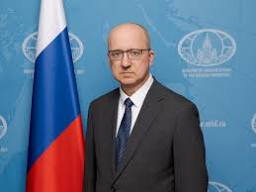
Ambassador Andrei Ordash says Moscow wants Ghana to serve as a strategic West African partner, with new cooperation proposed in investment, technology, agriculture, mining and human-capital development.
By Raw Reporters News Desk | Accra | August 6, 2026
ACCRA — Russia is seeking a broader economic and strategic partnership with Ghana, with its new ambassador, Andrei Ordash, identifying trade, nuclear energy, agriculture, mining, digital technology and education as priority areas for the next phase of relations between the two countries.
Ordash set out the agenda in a recent exclusive interview with Ghana News Agency reporter James Amoh Junior, describing Ghana as “a reliable and promising partner for Russia in West Africa.” The interview, published on July 20, presented Moscow’s effort to move the relationship beyond its traditional diplomatic and educational links towards investment, industrial cooperation and technology transfer.
The ambassador pointed to a sharp rise in bilateral trade, saying commerce between the two countries increased from US$247 million in 2022 to more than US$800 million in 2024. He said Russia now wants stronger business-to-business partnerships and a longer-term commercial presence in Ghana rather than a relationship built mainly around the sale of commodities.
Energy and industrial cooperation
Energy is one of the most significant areas raised in the interview. Ordash said an existing memorandum between the Ghana Atomic Energy Commission and Russia’s state nuclear corporation, Rosatom, could support future nuclear-power cooperation, including the training of Ghanaian specialists.
However, Ghana’s nuclear programme has not yet entered the construction stage. Ghana News Agency reported earlier this year that the programme remained in Phase Two under the International Atomic Energy Agency milestones framework, where site studies, institutional development, public communication and vendor negotiations must be completed before full construction activities can begin.
That distinction is important: Russia has signalled interest and technical capacity, but the ambassador’s comments do not amount to an announcement that Rosatom has been awarded Ghana’s first nuclear power plant.
Agriculture, mining and AfCFTA
In agriculture, Russia is proposing a shift from straightforward exports towards local production. Ordash said Moscow was prepared to increase fertiliser supplies while exploring agro-industrial facilities in Ghana and research cooperation aimed at improving agricultural technology and productivity.
He also identified Ghana’s gold and bauxite resources as possible areas for joint development and argued that the country’s position as host of the African Continental Free Trade Area Secretariat gives it additional strategic value to Russian companies.
Under that approach, Ghana could serve as a production and logistics base for Russian businesses seeking wider access to African markets. The ambassador said 65 Ghanaian businesspeople attended the Made in Russia international forum in November 2025, a sign that both sides are already trying to build direct private-sector contacts.
AI, cybersecurity and digital services
The Russian envoy also made a broad technology offer, naming artificial intelligence, cybersecurity, digital public services, financial technology and digital healthcare as potential fields for cooperation.
Russia, he said, could share experience from its large-scale digital government platforms and smart-city systems, while also working with Ghana on the protection of state information systems, critical infrastructure and financial data. He additionally raised telemedicine, electronic medical records and AI-assisted diagnosis as possible areas for health-sector collaboration.
These proposals are still at the cooperation and partnership stage. No financing package, procurement timetable or binding implementation schedule for the digital projects was announced in the interview.
Scholarships and people-to-people ties
Education remains one of the deepest links between Ghana and Russia. Ordash said more than 600 Ghanaian students were studying in Russia and that 120 government-quota places had been allocated to Ghanaian citizens for the 2026/27 academic year.
He cited growing university-to-university links in agriculture, engineering and technical education, including cooperation involving Takoradi Technical University, the University of Ghana and the University of Media, Arts and Communications. Russia also plans to expand scholarships, Russian-language programmes, youth exchanges and professional training.
A separate Ghana News Agency report on July 22 quoted the ambassador as saying Moscow wants educational exchanges and human-capital development to remain central to the bilateral relationship.
Diplomacy and the Russia–Africa Summit
On diplomacy, Ordash said Russia wants closer coordination with Ghana at the United Nations and other multilateral institutions. He highlighted Russia’s support for a UN resolution recognising the slave trade in Africans as a crime against humanity and said Russian researchers were prepared to contribute scientific and legal expertise to African work on reparations claims.
The ambassador also placed Ghana within Moscow’s wider Africa strategy ahead of the Third Russia–Africa Summit, scheduled for October 28–29, 2026, in Moscow. He said the summit would address trade, investment, energy, artificial intelligence, digitalisation and payment systems, with Ghana expected to play an important role in shaping future cooperation.
Five days after the GNA interview was published, Ordash paid a courtesy call on President John Dramani Mahama. According to GNA, the meeting covered trade, economic and investment cooperation, cultural and humanitarian ties and Ghana’s planned participation in the Russia–Africa Summit, giving the ambassador’s public agenda an early follow-up at the presidential level.
What the message means for Ghana
For Ghana, the Russian pitch offers possible alternatives in investment, energy technology, skills training and market access at a time when Accra is seeking industrial expansion and greater value addition. But the practical significance will depend on whether the proposals move from diplomatic statements and memoranda into financed projects, transparent agreements and operational joint ventures.
Ordash said he wants his tenure to be judged ultimately by stronger trust and concrete results. “The most important legacy I would like to leave behind is trust,” he told GNA.
For now, the clearest signal from Moscow is that it sees Ghana not only as a bilateral partner, but as a potential gateway for a larger Russian economic and technological presence in West Africa and across the AfCFTA market.