

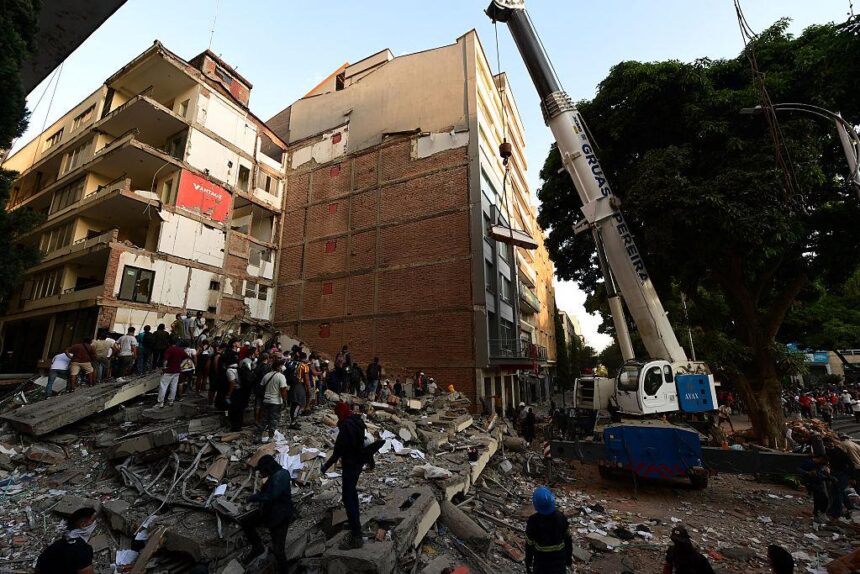
Western Colombia reels from its strongest earthquake of the century as Cali, Pereira and Chocó record heavy casualties, widespread building damage and continuing rescue operations
By Raw Reporters News Desk | August 11, 2026
BOGOTÁ, COLOMBIA — Colombia is confronting one of its most serious natural disasters in decades after a magnitude-7.4 earthquake struck the country’s western region on Monday, August 10, killing at least 164 people and leaving communities across the coffee-growing heartland struggling with widespread destruction. Rescue operations continued into Tuesday as emergency teams searched damaged and collapsed buildings for people still unaccounted for.
The Servicio Geológico Colombiano (SGC) recorded the main earthquake at 7:34 a.m. local time, locating it around San José del Palmar in the Chocó department, at a depth of approximately 103 kilometres. The United States Geological Survey independently assessed the earthquake at magnitude 7.4 and about 107 kilometres deep.
The SGC described the earthquake as the strongest recorded in Colombia in the 21st century, while powerful shaking was reported across a wide area of the country. The tremor was felt as far away as Bogotá, where residents evacuated buildings following the prolonged shaking.
Cali and Pereira among hardest-hit cities
Cali, one of Colombia’s largest cities, has emerged as one of the centres of the disaster. Reuters reported Tuesday that at least 85 people had been confirmed dead in Cali, where dozens of buildings were either destroyed or left structurally unstable.
The health system has also been affected. Parts of a hospital in Cali were severely damaged, forcing approximately 600 patients to receive medical attention outside the facility, according to its director. Emergency responders, soldiers, police officers and volunteers continued rescue operations throughout the night.
In Pereira, capital of Risaralda department, authorities reported 66 deaths, according to Reuters. Residential structures and other buildings sustained extensive damage, while the city’s airport was also affected and required structural inspection.
Another 13 deaths were reported in Chocó, the largely rural department closest to the earthquake’s epicentral area. Access to some affected communities has complicated assessments and emergency operations.
The overall casualty figures remain fluid. While Reuters reported at least 164 confirmed deaths early Tuesday, the Associated Press said some local authorities were reporting higher cumulative figures as information continued arriving from affected municipalities. Thousands of people had also been reported missing or had not yet been accounted for, meaning the scale of the disaster could change substantially as rescue and verification operations progress.
National emergency declared
Colombian President Abelardo De La Espriella, who assumed office only days before the disaster, declared a national state of emergency and ordered government resources to be mobilised to the affected regions. His administration has identified rescue operations, emergency healthcare, shelter and humanitarian assistance as immediate priorities.
Security forces have also been deployed to several affected areas following reports of disorder and attempted looting. Curfews were imposed in Cali and Pereira, while additional personnel were sent to assist local authorities with security and disaster-response operations.
Several regional airports, including those serving Pereira, Manizales, Quibdó, Armenia, Cartago and Buenaventura, temporarily suspended operations while engineers inspected infrastructure for structural damage.
The disaster has also disrupted Colombian football. South American governing body CONMEBOL postponed continental club matches involving Colombian teams, while Colombia’s domestic football authorities suspended league games scheduled for the week.
Aftershocks keep residents on alert
The initial earthquake was followed by a series of aftershocks. The Colombian Geological Service had recorded at least 21 aftershocks by late Monday, and authorities warned that additional seismic activity was possible.
SGC records show that a magnitude-4.8 earthquake was registered around San José del Palmar less than an hour after the main event.
Colombia lies within a highly complex tectonic environment influenced by interactions among major crustal plates along the eastern margin of the Pacific’s seismically active region. Earthquakes are therefore relatively common, although events of Monday’s magnitude and destructive impact are much less frequent.
Memories of Colombia’s devastating 1999 earthquake
The destruction has revived memories of the 1999 Armenia earthquake, which devastated Colombia’s coffee-growing region and killed more than 1,000 people. Monday’s earthquake again struck areas including Pereira and other communities that were heavily affected by the 1999 disaster.
The latest disaster is also particularly significant because the SGC says the magnitude-7.4 event was the country’s strongest earthquake recorded so far this century.
Search-and-rescue race continues
Emergency workers, police, military personnel and civilian volunteers continued searching damaged structures on Tuesday. Heavy machinery was deployed in some areas while specialist teams worked to locate people reported missing.
Authorities face the simultaneous challenge of rescuing survivors, treating the injured, assessing thousands of buildings, restoring transportation networks and providing temporary accommodation to families whose homes are no longer safe.
With casualty reports still being reconciled among national and local agencies, officials have warned that the death toll could rise as rescue teams reach communities that have been difficult to access.
For Colombia, the earthquake has rapidly become a major test of national disaster preparedness and the capacity of the country’s emergency, healthcare and infrastructure systems to respond to a catastrophe affecting several departments simultaneously.