

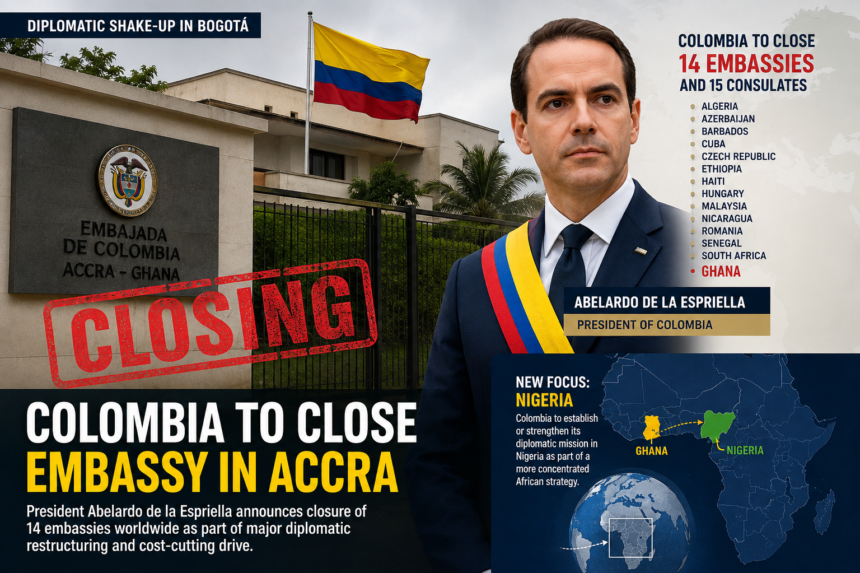
Bogotá’s decision comes just months after Ghana and Colombia expanded political and maritime cooperation, but evidence points to a sweeping diplomatic restructuring—not a breakdown in relations with Accra.
By Raw Reporters News Desk
Accra, Ghana | August 11, 2026
ACCRA — Colombia’s decision to close its embassy in Ghana is not, on available evidence, the result of a diplomatic dispute with Accra. It is part of one of the most significant restructurings of Colombia’s overseas diplomatic network in recent years.
The move nevertheless presents an intriguing contradiction.
Just months before the closure announcement, Ghana and Colombia were strengthening political consultations and pursuing deeper trade and maritime cooperation. Ghana was also being positioned as a possible West African gateway for Colombian commerce.
Yet Ghana is now among 14 countries whose Colombian embassies have been earmarked for closure, alongside Algeria, Azerbaijan, Barbados, Cuba, the Czech Republic, Ethiopia, Haiti, Hungary, Malaysia, Nicaragua, Romania, Senegal and South Africa. Colombia also plans to shut about 15 consulates.
The policy was announced while Abelardo de la Espriella was president-elect. He subsequently assumed office on August 7, 2026, succeeding Gustavo Petro and beginning a government promising fiscal austerity, a smaller state and a significant ideological shift in domestic and foreign policy.
The central question for Ghana is therefore not simply why an embassy is being closed.
It is why Accra was selected for closure at precisely the moment Ghana-Colombia relations appeared to be expanding.
Embassy closure does not automatically mean diplomatic rupture
One important distinction has been blurred in some public discussions surrounding the announcement.
Colombia is closing its resident embassy in Ghana; it has not announced the termination of diplomatic relations with Ghana.
De la Espriella indicated when announcing the restructuring that the closures, with the notable cases of Cuba and Nicaragua, should not automatically be interpreted as severing diplomatic relations with the affected states. Colombia intends to use forms of concurrent diplomatic accreditation to cover some countries from other missions.
That distinction matters.
An embassy is the physical resident representation of a country. Diplomatic relations can continue without a resident embassy, with an ambassador based in another country accredited concurrently to Ghana.
What changes is the frequency, immediacy and institutional depth of diplomatic presence on the ground.
A dramatic reversal after more than a decade in Accra
Colombia opened its resident embassy in Ghana in 2013, significantly upgrading a bilateral relationship that dates back decades. Contemporary Ghanaian reports described the Accra mission as an important step in strengthening Colombia’s engagement with West Africa.
That presence expanded under former President Gustavo Petro.
Petro’s administration deliberately sought closer political, economic and cultural ties with Africa, with former Vice-President Francia Márquez becoming a prominent figure in Colombia’s outreach to African countries.
Ghana became an important part of that strategy.
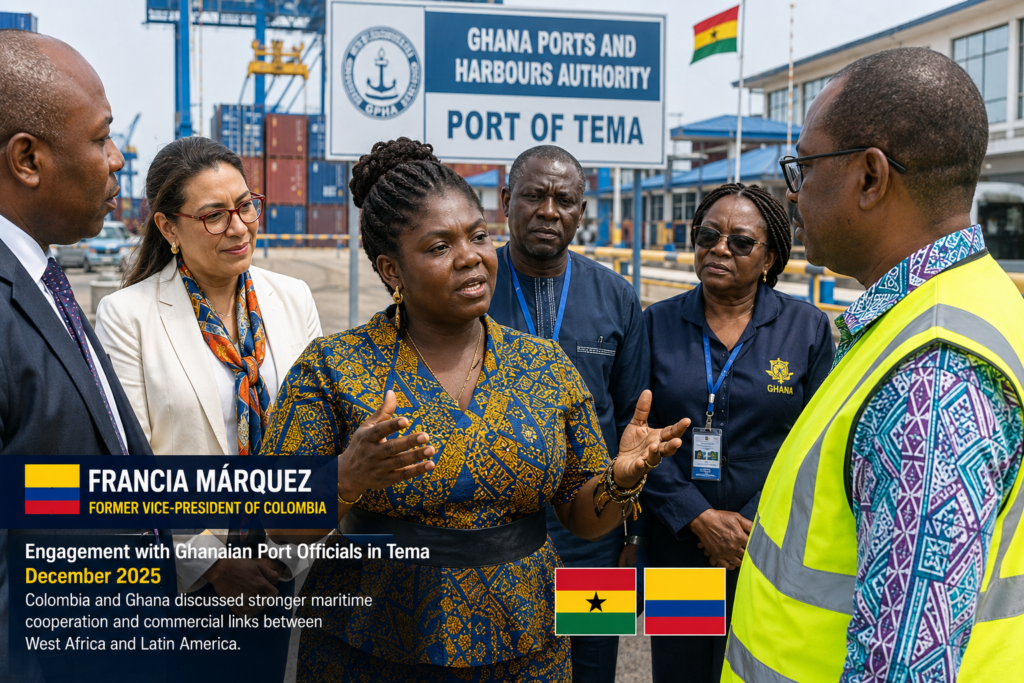
In December 2025, Márquez led a high-level Colombian delegation to Ghana and visited the Ghana Ports and Harbours Authority, where discussions focused on trade, investment and the possibility of direct maritime connectivity between the two countries.
That makes the new policy striking: a diplomatic presence strengthened as part of Colombia’s Africa engagement under Petro is now being substantially recalibrated under De la Espriella.
The Tema–Cartagena connection complicates the story
The strongest evidence that the embassy closure should not simply be interpreted as declining Ghana-Colombia relations comes from events earlier this year.
On March 17, 2026, Ghana and Colombia held their Fourth Session of Political Consultations in Bogotá. Ghana’s delegation was led by Deputy Minister for Foreign Affairs James Gyakye Quayson, with both sides discussing deeper bilateral cooperation and international issues.
Days later, Ghana and Colombia moved forward with an agreement aimed at establishing direct maritime connectivity between the Port of Tema and the Port of Cartagena.
The initiative is intended to strengthen commercial links between West Africa and Latin America and build on earlier discussions led by Márquez during her December 2025 visit to Tema.
The Colombian delegation had specifically identified Ghana’s geographic and commercial position as potentially useful for accessing markets beyond Ghana itself.
Ghanaian port officials similarly highlighted Tema’s capacity to serve trade routes involving landlocked West African markets.
That creates the central paradox of the embassy decision:
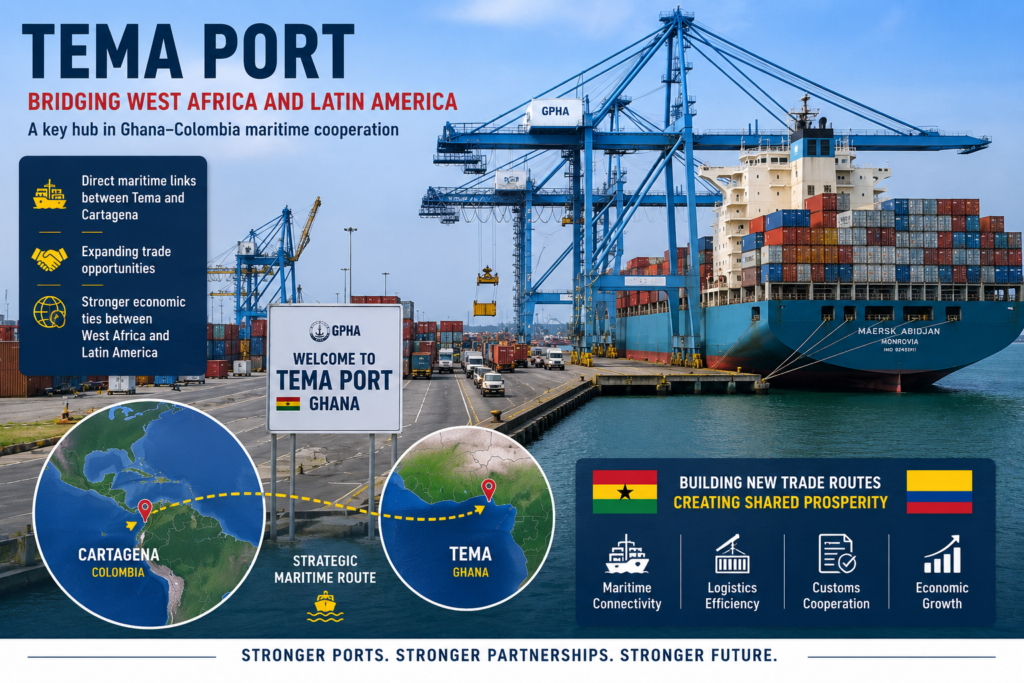
Why eliminate a resident diplomatic presence in a country that Colombia was simultaneously cultivating as a commercial and maritime gateway?
The answer appears to lie less in Ghana’s importance and more in how Colombia’s new government defines diplomatic efficiency.
The Nigeria pivot
Another major clue is Bogotá’s plan to establish a diplomatic mission in Nigeria.
De la Espriella announced shortly before taking office that Colombia intended to open an embassy in Nigeria as part of an effort to strengthen its relations with Africa. The announcement came alongside the wider reduction of Colombian missions elsewhere on the continent.
This significantly changes the interpretation of the Ghana closure.
Colombia is not withdrawing entirely from Africa.
It appears instead to be concentrating diplomatic resources in selected countries.
Nigeria offers obvious strategic scale: it is one of Africa’s largest national markets and populations and carries substantial political weight in West Africa.
From Bogotá’s perspective, concentrating resources in Abuja while using concurrent accreditation for neighbouring states could potentially reduce the cost of maintaining numerous separate missions.
But that strategy also carries limitations.
Nigeria cannot replicate Ghana’s specific diplomatic and commercial advantages.
Accra hosts an extensive diplomatic community and provides direct access to Ghanaian institutions, businesses and the African Continental Free Trade Area ecosystem. Tema also provides Colombia with a distinct maritime and logistics proposition.
The Nigeria decision should therefore be understood as a strategic prioritisation, rather than evidence that Ghana has ceased to matter.
Austerity is at the centre of De la Espriella’s argument
The official political argument advanced for the diplomatic shake-up is financial efficiency.
De la Espriella has criticised what he considers an expensive overseas diplomatic structure that produces insufficient measurable returns. His wider administration has entered office promising significant reductions in government expenditure and the size of the Colombian state.
Embassies are expensive operations.
They require diplomatic personnel, local employees, accommodation, security, transportation, administrative systems, consular facilities and other operational expenditure.
The policy question, however, is whether savings achieved by closing individual missions outweigh the trade, political and strategic opportunities that resident diplomatic representation can generate.
For Ghana, that calculation is particularly relevant because bilateral engagement had been accelerating rather than declining.
No evidence of an anti-Ghana diplomatic action
Raw Reporters’ review of available diplomatic developments does not indicate a political confrontation between Accra and Bogotá preceding the decision.
Quite the opposite.
Ghana and Colombia have continued formal political consultations, expanded discussions on commercial cooperation and implemented a visa-waiver arrangement covering holders of diplomatic, official and service passports.
The Colombian Embassy in Accra itself described the visa agreement as another step in cooperation between the two governments.
These developments would be difficult to reconcile with a theory that the embassy closure was triggered by a serious bilateral dispute.
The more strongly supported explanation is that Ghana has been caught in a larger reorganisation of Colombia’s foreign service following a major political transition in Bogotá.
Petro’s Africa policy gives way to De la Espriella’s approach
The diplomatic restructuring also reflects the sharp political transition between former President Gustavo Petro and President De la Espriella.
Under Petro, Colombia broadened relations with Africa and sought stronger engagement with countries historically connected to Colombia through the African diaspora.
Francia Márquez’s diplomacy was central to that effort, including her December 2025 Ghana visit and engagement with the Port of Tema.
De la Espriella entered office signalling a substantially different international orientation.
His government has already moved to reverse elements of Petro’s foreign policy, including restoring relations with Israel, while announcing cuts to diplomatic posts abroad and breaking relations with Cuba and Nicaragua.
Viewed in that context, the Ghana closure becomes part of a much wider ideological and fiscal recalibration.
It is therefore better understood as a change in Bogotá’s diplomatic architecture than as a Ghana-specific foreign policy decision.
What Ghana could lose
The consequences should still not be underestimated.
Diplomatic relations can survive without an embassy, but diplomatic intensity is not necessarily the same.
A resident Colombian mission gives Ghanaian ministries, companies, universities, cultural institutions and other organisations immediate access to Colombian diplomats.
It also allows Colombian officials to monitor commercial opportunities, regulatory developments and political changes in Ghana continuously.
Once Ghana is covered from another capital, some interactions may require additional layers of coordination.
That could matter particularly for emerging initiatives such as the Tema–Cartagena maritime relationship.
The critical issue will therefore be whether Bogotá creates a clear mechanism for maintaining the momentum of bilateral cooperation after the physical mission in Accra closes.
The unanswered question: What happens to the new trade agenda?
The embassy decision leaves several important questions unresolved.
There has been no indication in the announcements reviewed that the Ghana-Colombia port cooperation initiative has been cancelled. Recent bilateral consultations similarly demonstrate an institutional relationship extending beyond the embassy itself.
That means the next stage of this story will depend on implementation.
If Colombia maintains active diplomatic coverage of Ghana, supports the maritime agreement and continues political consultations, the embassy closure could ultimately prove to be largely an administrative restructuring.
If engagement subsequently slows, however, Ghana could become an example of the trade-off involved when governments pursue diplomatic austerity at the expense of permanent representation.
Raw Reporters Analysis
The evidence available so far points to three principal forces behind Colombia’s decision: fiscal austerity, a change of government and the concentration of diplomatic resources in strategically selected locations such as Nigeria.
There is presently no credible evidence of a Ghana-Colombia diplomatic crisis behind the closure.
Indeed, the deeper contradiction is that relations between the two countries had recently been strengthening.
The real test, therefore, will not be whether the Colombian flag continues to fly over an embassy building in Accra.
It will be whether Bogotá can close that building without closing the economic and diplomatic opportunities that Ghana and Colombia spent years building.