

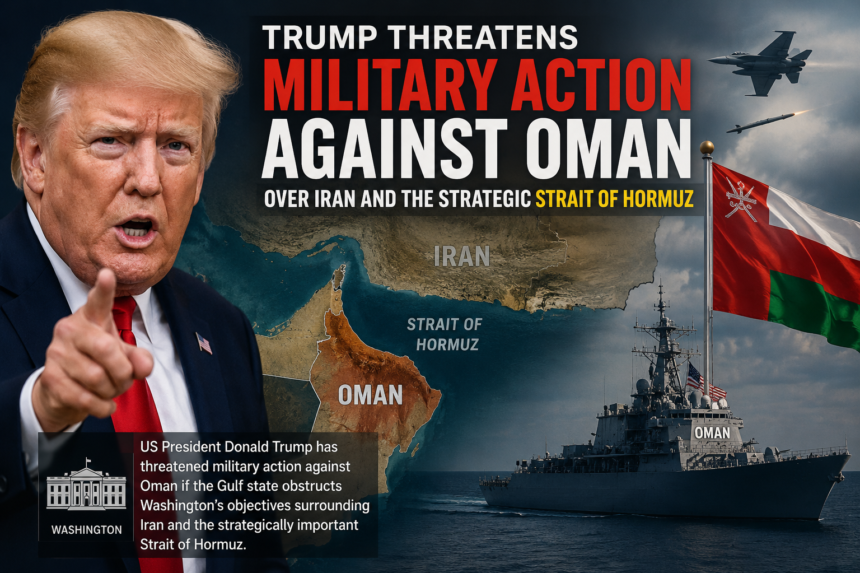
US president issues extraordinary warning against longtime Gulf partner as Washington increases pressure over Iran and the strategic Strait of Hormuz
WASHINGTON/MUSCAT, August 18, 2026 — United States President Donald Trump has threatened military action against Oman, warning that Washington could bomb the Gulf state if it “gets in the way” of US objectives surrounding Iran and the strategically vital Strait of Hormuz.
The extraordinary warning was delivered during a telephone interview with Fox News correspondent Trey Yingst on Monday, August 17, as Trump discussed stalled efforts to reach an agreement with Iran and the future operation of the Strait of Hormuz. Trump said that if Oman obstructed Washington’s plans, the United States would bomb the country, using an expletive to emphasise the threat.
The remarks represent a significant escalation in tensions between Washington and Muscat, despite Oman’s longstanding role as a diplomatic intermediary between the United States and Iran.
Oman-Iran talks at centre of dispute
The immediate dispute centres on negotiations involving Oman and Iran over commercial shipping through the Strait of Hormuz, one of the world’s most important maritime energy corridors. Before the current conflict disrupted traffic, roughly one-fifth of global oil and liquefied natural gas supplies passed through the waterway.
Oman sits on the southern side of the narrow strait opposite Iran and has historically attempted to maintain constructive relations with both Tehran and Washington.
Iran and Oman have been discussing arrangements aimed at restoring greater commercial traffic through the waterway. The United States has made the full reopening of the strait an important element of its broader strategy toward Iran.
Trump’s warning therefore raises the stakes around what had largely been a diplomatic effort to resolve control and navigation disagreements surrounding the strategic passage.
Trump says Iran must surrender
Trump’s comments on Oman came alongside renewed pressure on Tehran.
Speaking about the stalled negotiations, the US president said Iran was unlikely to accept the type of agreement Washington considers necessary and repeated his position that Iran must not acquire a nuclear weapon. He also said the United States was not seeking an extension of the interim memorandum reached with Tehran in June.
That arrangement had called for an end to military operations and negotiations towards a more comprehensive agreement within 60 days. The framework subsequently unravelled, and the 60-day period reached its deadline on August 17 without a final settlement.
Later, while speaking to reporters in the Oval Office, Trump accused Oman of not having “behaved very well” and suggested Washington could deal with the Gulf country easily.
Not Trump’s first warning to Oman
Monday’s statement was not the first time Trump has issued a military threat against Muscat.
The Associated Press reported that during a Cabinet meeting in May, Trump warned that Oman would have to cooperate with Washington or face severe consequences.
The latest remarks are particularly significant because Oman has traditionally occupied an unusual diplomatic position in the Middle East, maintaining communication channels with Iran while simultaneously sustaining longstanding relations with the United States.
Oman previously hosted and mediated indirect nuclear negotiations between Washington and Tehran, including talks in Muscat earlier in 2026.
Strait of Hormuz raises global stakes
The confrontation carries implications far beyond Oman and Iran.
Disruptions in the Strait of Hormuz have already placed pressure on international energy markets. Reuters reported that uncertainty surrounding negotiations and shipping through the strait contributed to higher oil prices as markets assessed the possibility of further regional escalation.
Any deterioration in relations involving Oman could complicate attempts to use Muscat as a diplomatic bridge between Washington and Tehran and introduce another dimension to an already volatile regional confrontation.
The situation is also attracting attention inside the United States. The Associated Press reported that Democratic Senator Tim Kaine moved to introduce a War Powers Resolution aimed at restricting military action against Oman following Trump’s warning.
As of Tuesday, August 18, 2026, the available authoritative reporting reviewed for this publication did not establish that the United States had initiated military action against Oman. Trump’s statement should therefore be understood as a threat of possible military action, not an announcement that an attack has begun.
The development nevertheless marks a sharp deterioration in rhetoric between Washington and a country that has long served as one of the Gulf region’s most important diplomatic intermediaries.
Raw Reporters News Desk