

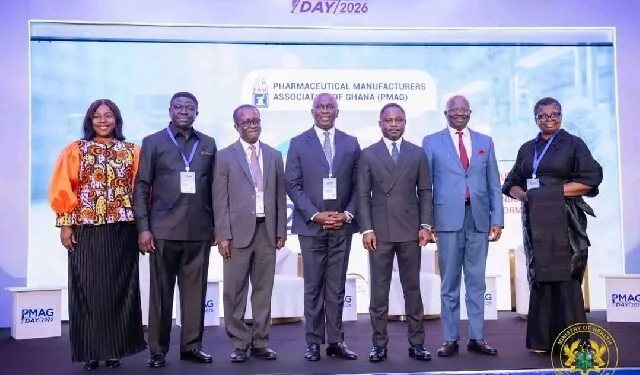
ACCRA — In a definitive push to end Ghana’s reliance on imported medicines, stakeholders in the pharmaceutical sector gathered yesterday, July 28, at the Alisa Hotel in Accra for the 2026 Pharmaceutical Manufacturers Association of Ghana (PMAG) Day. Marking the association’s 27th anniversary, the conference framed local drug manufacturing not merely as a healthcare necessity, but as a critical pillar of national security and economic transformation. With the country currently importing over 70 percent of its medicines, the event served as an urgent call to action.
Operating under the theme “Advancing Ghana’s Pharmaceutical Sovereignty Through Innovation, Requisite Skills Mix and Quality Industrial Value Chain for Economic Transformation,” the summit drew a powerful cross-section of government officials, international diplomats, regulators, and industry leaders. High-profile attendees included the Minister for Health, Kwabena Mintah Akandoh; Presidential Advisor on the 24-Hour Economy, Augustus Goosie Tanoh; European Union Ambassador to Ghana, Rune Skinnebach; and Deputy Head of Cooperation at the German Embassy, Daniel Boehme.
Key Takeaways and Strategic Recommendations
The central consensus of the conference was stark: Ghana’s current import dependence places unsustainable pressure on foreign exchange reserves and leaves the nation vulnerable to global supply chain shocks. To reverse this, delegates outlined several major decisions and policy recommendations:
- Transitioning Beyond Generic Assembly: A unanimous decision was made to aggressively pivot investments toward the local production of Active Pharmaceutical Ingredients (APIs), specialized formulations, and vaccines, capturing the full industrial value chain rather than stopping at the packaging of basic generics.
- The 24-Hour Economy Integration: Presidential Advisor Augustus Goosie Tanoh outlined how the administration’s 24-Hour Economy policy will be leveraged to optimize pharmaceutical manufacturing plants, drastically increasing output and operational efficiency to meet both domestic demand and export targets within the African Continental Free Trade Area (AfCFTA).
- Redefining the Skills Mix & Quality Control: Industry leaders advocated for a paradigm shift in workforce training. A key recommendation was the deeper integration of academia with the manufacturing sector to produce GMP-ready professionals. Stakeholders emphasized the operational necessity of directly embedding pharmacists onto the pharmaceutical manufacturing production line. This strategy bridges the gap between clinical knowledge and industrial output, ensuring that rigorous current Good Manufacturing Practices (cGMP) and quality control protocols are strictly maintained from the raw material stage to the finished product.
- International Cooperation & The PharmaVax Initiative: Ambassador Skinnebach and Daniel Boehme reaffirmed commitments to the jointly funded PharmaVax Ghana Programme. Implemented by GIZ as part of the Team Europe Initiative, this program will continue to receive targeted funding to scale up local vaccine manufacturing capacities and fortify the ecosystem.
The Innovation Exhibition: Showcasing Made-in-Ghana Excellence
A major highlight of PMAG Day 2026 was the dynamic innovation exhibition, which transformed sections of the Alisa Hotel into a showcase of local industrial capability. PMAG member companies displayed a vast array of Made-in-Ghana medicines, state-of-the-art packaging technologies, and breakthrough pharmaceutical innovations.
The exhibition floor highlighted not only conventional allopathic medicines but also the growing sophistication of domestic herbal formulation. Several booths showcased advances in compounding chemistry designed to scale up traditional herbal monographs into standardized, commercially viable therapies. This underscores a strategic move to capitalize on indigenous botanical resources using modern scientific methods.
Furthermore, the exhibition placed a heavy emphasis on advanced analytical quality control. Manufacturers demonstrated the latest in laboratory instrumentation, highlighting high-performance liquid chromatography (HPLC) applications used for stringent purity testing. Demonstrations of analytical lab reports assessing the purity and quality of complex injectables—such as prednisolone acetate—served as proof of the sector’s readiness to meet and exceed international regulatory standards. By showcasing these capabilities, PMAG members sent a clear message: local production does not mean a compromise on quality.
Looking Ahead
As the 27th anniversary celebrations concluded, PMAG honoured past presidents and staunch supporters who have championed medicine security. The roadmap laid out at the Alisa Hotel sets a rigorous, collaborative agenda for the coming years. With strategic investments, a reimagined workforce, and deep cross-sector collaboration, Ghana’s pharmaceutical sector is positioning itself not just for national sovereignty, but as the premier healthcare manufacturing hub of West Africa.