

Record 2025 production pushes Ghana ahead of United States as gold strengthens exports, foreign exchange inflows and economic stability — but illegal mining and weak value addition remain major tests
ACCRA, Ghana — August 18, 2026 — Ghana has risen to become the sixth-largest gold-producing country in the world, strengthening its position as Africa’s leading gold producer and placing the West African nation among the most important players in the global bullion industry.
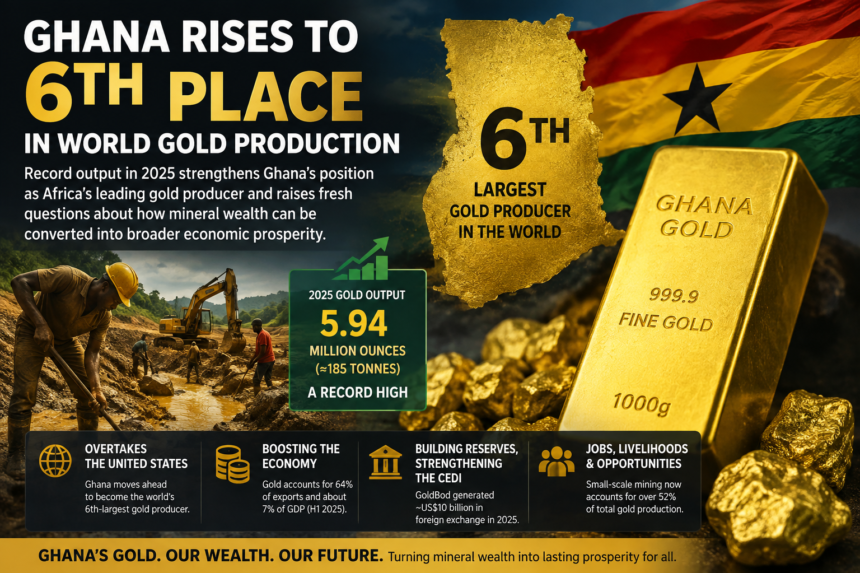
The new ranking follows a record expansion in Ghana’s gold production in 2025, when the country produced approximately 5.94 million ounces — about 185 tonnes — of gold, according to figures cited by the Ghana Chamber of Mines. The increase was enough for Ghana to overtake the United States, which had traditionally ranked ahead of the country.
According to Christopher Nyarko, Director of Analysis, Research and Finance at the Ghana Chamber of Mines, Ghana now follows China, Russia, Australia, Canada and Peru in the ranking used by the Chamber. He noted, however, that the precise ordering of the world’s leading producers can vary depending on the international dataset used.
The World Gold Council confirms that China remained the world’s largest gold-producing country in 2025 and says its country-level production data are updated annually using Metals Focus data, underscoring the importance of methodology when comparing international rankings.
Small-scale mining drives historic production surge
Perhaps the most significant development behind Ghana’s rise is the transformation taking place within the artisanal and small-scale mining sector.
Small-scale miners accounted for approximately 52.38 percent of Ghana’s total gold production in 2025, overtaking large-scale mining companies for the first time in more than a century of commercial gold mining in the country.
Provisional industry data earlier showed artisanal and small-scale mining producing roughly 3.1 million ounces, compared with about 2.9 million ounces from large-scale mines. Industry officials attributed the increase partly to high international gold prices and reforms that channelled more previously informal gold into official markets.
GoldBod subsequently reported that artisanal and small-scale gold exports increased from about 63 tonnes in 2024 to 104 tonnes in 2025, generating approximately US$10.8 billion in export revenue.
This is significant for an economy in which gold has become increasingly important not simply as a mineral export, but as an instrument of macroeconomic policy.
What the ranking means for Ghana’s economy
Ghana’s emergence as the world’s sixth-largest producer gives the country considerably greater economic leverage — but production volume alone does not automatically translate into national prosperity.
The first major benefit is foreign exchange generation.
Ghana’s Ministry of Finance reported that gold accounted for about 64 percent of the country’s total exports during the first half of 2025 and that the gold sector contributed approximately 7 percent of GDP.
That level of export dominance makes gold one of Ghana’s strongest sources of foreign currency. Increased formal exports can improve the supply of dollars and other major currencies into the domestic market, strengthen the country’s external position and reduce some of the pressure historically placed on the Ghana cedi.
The government has increasingly incorporated gold into its reserve-management strategy. Under its current framework, GoldBod has been mandated to aggregate gold, generate foreign exchange and support the accumulation of national reserves. The Ministry of Finance said GoldBod generated approximately US$10 billion in foreign exchange during 2025, while government is pursuing a broader gold-backed reserve accumulation programme.
GoldBod says government is targeting purchases worth at least US$20 billion in 2026 as part of plans to strengthen foreign-exchange reserves and increase the amount of Ghanaian gold passing through formal channels.
Stronger export earnings and cedi stability
A larger and more transparent gold-export industry can strengthen Ghana’s balance of payments.
When export earnings rise substantially relative to imports, the country has greater capacity to finance essential imports, service external obligations and build foreign reserves.
But gold production should not be presented as the sole explanation for currency movements. Exchange-rate stability also depends on fiscal discipline, monetary policy, imports, capital flows, debt servicing, market expectations and other export sectors such as cocoa and petroleum.
The Ministry of Finance itself has attributed improvements in Ghana’s external position to a combination of strong gold and cocoa exports, reserve accumulation and wider macroeconomic reforms.
Government revenue could increase — if Ghana captures its share
Higher gold production also creates an opportunity for increased government revenue through royalties, corporate taxes, licence fees and other statutory payments.
The central economic question, however, is no longer simply how much gold Ghana produces, but how much value Ghana retains from every ounce produced.
A country may rank among the world’s largest mineral producers while receiving only a fraction of the ultimate value generated by its resources if refining, bullion trading, jewellery manufacturing, financing and other higher-value activities occur outside the domestic economy.
Government’s current strategy therefore includes increasing domestic refining and requiring portions of gold purchased under national programmes to be processed locally before being incorporated into reserves or traded internationally.
If successfully implemented, this could gradually move Ghana beyond its traditional role as principally an exporter of raw or semi-processed mineral resources.
Jobs and local businesses could benefit
The rise of small-scale mining also highlights gold’s enormous employment potential.
Formalisation could create stronger opportunities for licensed miners, geologists, mining engineers, assayers, environmental scientists, equipment suppliers, transport operators, financial institutions and businesses serving mining communities.
It could also enable government to collect revenues from economic activity that previously remained outside the formal system.
However, rapid expansion of artisanal mining creates an equally significant governance challenge.
The galamsey contradiction
Ghana’s sixth-place ranking comes with a serious paradox: the same small-scale mining sector driving record production has also been associated with some of the country’s most serious environmental problems when mining takes place illegally.
Illegal mining — commonly known as galamsey — continues to threaten rivers, forests, agricultural land and mining communities.
Government has acknowledged that illegal mining and gold smuggling remain major risks despite improvements in formalisation. GoldBod says continued illegal operations deprive the state of revenue while creating environmental and public-health consequences.
That means Ghana’s gold success cannot ultimately be measured in ounces alone.
If increased production is accompanied by polluted water bodies, destroyed cocoa farms, abandoned mining pits and lost agricultural livelihoods, part of the economic benefit will effectively be offset by environmental restoration costs and long-term social damage.
The bigger opportunity: From Gold Coast to a gold economy
Ghana’s new global ranking presents the country with an opportunity to rethink the structure of its mining economy.
For decades, the country has been known internationally for its mineral wealth. The challenge now is to transform geological advantage into sustainable industrial development.
That would require stronger local refining, internationally certified bullion production, jewellery manufacturing, mining-equipment services, geological research, mineral-processing technology and greater Ghanaian participation in financing and ownership throughout the mining value chain.
It would also require transparent accounting of production and exports so that every legally mined ounce can be traced and the appropriate taxes, royalties and foreign exchange captured.
The Ghana Chamber of Mines expects national production to rise further in 2026, projecting between 6.1 million and 6.7 million ounces if industry conditions remain supportive.
But the industry’s future will also depend on the balance government strikes between obtaining a greater fiscal return from Ghana’s mineral resources and maintaining an investment environment capable of financing new mines and extending existing operations. Mining companies have already raised concerns about proposed changes to the mineral royalty structure and their possible effects on future investment.
A ranking that must reach ordinary Ghanaians
Becoming the world’s sixth-largest gold producer is unquestionably a major milestone for Ghana.
But its true significance will be determined by what happens next.
For ordinary Ghanaians, the ranking will have greater meaning if record production translates into stronger public finances, a more resilient currency, sustainable employment, improved infrastructure in mining communities, environmental protection and greater domestic ownership of the gold value chain.
Ghana has demonstrated that it possesses the geological resources and production capacity to compete with the world’s major gold-producing nations.
The next challenge is considerably more important: turning gold production leadership into broad-based national wealth.
Ghana Climbs to World’s 6th-Largest Gold Producer as Record Output Reshapes Economic Outlook
Record 2025 production pushes Ghana ahead of United States as gold strengthens exports, foreign exchange inflows and economic stability — but illegal mining and weak value addition remain major tests
ACCRA, Ghana — August 18, 2026 — Ghana has risen to become the sixth-largest gold-producing country in the world, strengthening its position as Africa’s leading gold producer and placing the West African nation among the most important players in the global bullion industry.
The new ranking follows a record expansion in Ghana’s gold production in 2025, when the country produced approximately 5.94 million ounces — about 185 tonnes — of gold, according to figures cited by the Ghana Chamber of Mines. The increase was enough for Ghana to overtake the United States, which had traditionally ranked ahead of the country.
According to Christopher Nyarko, Director of Analysis, Research and Finance at the Ghana Chamber of Mines, Ghana now follows China, Russia, Australia, Canada and Peru in the ranking used by the Chamber. He noted, however, that the precise ordering of the world’s leading producers can vary depending on the international dataset used.
The World Gold Council confirms that China remained the world’s largest gold-producing country in 2025 and says its country-level production data are updated annually using Metals Focus data, underscoring the importance of methodology when comparing international rankings.
Small-scale mining drives historic production surge
Perhaps the most significant development behind Ghana’s rise is the transformation taking place within the artisanal and small-scale mining sector.
Small-scale miners accounted for approximately 52.38 percent of Ghana’s total gold production in 2025, overtaking large-scale mining companies for the first time in more than a century of commercial gold mining in the country.
Provisional industry data earlier showed artisanal and small-scale mining producing roughly 3.1 million ounces, compared with about 2.9 million ounces from large-scale mines. Industry officials attributed the increase partly to high international gold prices and reforms that channelled more previously informal gold into official markets.
GoldBod subsequently reported that artisanal and small-scale gold exports increased from about 63 tonnes in 2024 to 104 tonnes in 2025, generating approximately US$10.8 billion in export revenue.
This is significant for an economy in which gold has become increasingly important not simply as a mineral export, but as an instrument of macroeconomic policy.
What the ranking means for Ghana’s economy
Ghana’s emergence as the world’s sixth-largest producer gives the country considerably greater economic leverage — but production volume alone does not automatically translate into national prosperity.
The first major benefit is foreign exchange generation.
Ghana’s Ministry of Finance reported that gold accounted for about 64 percent of the country’s total exports during the first half of 2025 and that the gold sector contributed approximately 7 percent of GDP.
That level of export dominance makes gold one of Ghana’s strongest sources of foreign currency. Increased formal exports can improve the supply of dollars and other major currencies into the domestic market, strengthen the country’s external position and reduce some of the pressure historically placed on the Ghana cedi.
The government has increasingly incorporated gold into its reserve-management strategy. Under its current framework, GoldBod has been mandated to aggregate gold, generate foreign exchange and support the accumulation of national reserves. The Ministry of Finance said GoldBod generated approximately US$10 billion in foreign exchange during 2025, while government is pursuing a broader gold-backed reserve accumulation programme.
GoldBod says government is targeting purchases worth at least US$20 billion in 2026 as part of plans to strengthen foreign-exchange reserves and increase the amount of Ghanaian gold passing through formal channels.
Stronger export earnings and cedi stability
A larger and more transparent gold-export industry can strengthen Ghana’s balance of payments.
When export earnings rise substantially relative to imports, the country has greater capacity to finance essential imports, service external obligations and build foreign reserves.
But gold production should not be presented as the sole explanation for currency movements. Exchange-rate stability also depends on fiscal discipline, monetary policy, imports, capital flows, debt servicing, market expectations and other export sectors such as cocoa and petroleum.
The Ministry of Finance itself has attributed improvements in Ghana’s external position to a combination of strong gold and cocoa exports, reserve accumulation and wider macroeconomic reforms.
Government revenue could increase — if Ghana captures its share
Higher gold production also creates an opportunity for increased government revenue through royalties, corporate taxes, licence fees and other statutory payments.
The central economic question, however, is no longer simply how much gold Ghana produces, but how much value Ghana retains from every ounce produced.
A country may rank among the world’s largest mineral producers while receiving only a fraction of the ultimate value generated by its resources if refining, bullion trading, jewellery manufacturing, financing and other higher-value activities occur outside the domestic economy.
Government’s current strategy therefore includes increasing domestic refining and requiring portions of gold purchased under national programmes to be processed locally before being incorporated into reserves or traded internationally.
If successfully implemented, this could gradually move Ghana beyond its traditional role as principally an exporter of raw or semi-processed mineral resources.
Jobs and local businesses could benefit
The rise of small-scale mining also highlights gold’s enormous employment potential.
Formalisation could create stronger opportunities for licensed miners, geologists, mining engineers, assayers, environmental scientists, equipment suppliers, transport operators, financial institutions and businesses serving mining communities.
It could also enable government to collect revenues from economic activity that previously remained outside the formal system.
However, rapid expansion of artisanal mining creates an equally significant governance challenge.
The galamsey contradiction
Ghana’s sixth-place ranking comes with a serious paradox: the same small-scale mining sector driving record production has also been associated with some of the country’s most serious environmental problems when mining takes place illegally.
Illegal mining — commonly known as galamsey — continues to threaten rivers, forests, agricultural land and mining communities.
Government has acknowledged that illegal mining and gold smuggling remain major risks despite improvements in formalisation. GoldBod says continued illegal operations deprive the state of revenue while creating environmental and public-health consequences.
That means Ghana’s gold success cannot ultimately be measured in ounces alone.
If increased production is accompanied by polluted water bodies, destroyed cocoa farms, abandoned mining pits and lost agricultural livelihoods, part of the economic benefit will effectively be offset by environmental restoration costs and long-term social damage.
The bigger opportunity: From Gold Coast to a gold economy
Ghana’s new global ranking presents the country with an opportunity to rethink the structure of its mining economy.
For decades, the country has been known internationally for its mineral wealth. The challenge now is to transform geological advantage into sustainable industrial development.
That would require stronger local refining, internationally certified bullion production, jewellery manufacturing, mining-equipment services, geological research, mineral-processing technology and greater Ghanaian participation in financing and ownership throughout the mining value chain.
It would also require transparent accounting of production and exports so that every legally mined ounce can be traced and the appropriate taxes, royalties and foreign exchange captured.
The Ghana Chamber of Mines expects national production to rise further in 2026, projecting between 6.1 million and 6.7 million ounces if industry conditions remain supportive.
But the industry’s future will also depend on the balance government strikes between obtaining a greater fiscal return from Ghana’s mineral resources and maintaining an investment environment capable of financing new mines and extending existing operations. Mining companies have already raised concerns about proposed changes to the mineral royalty structure and their possible effects on future investment.
A ranking that must reach ordinary Ghanaians
Becoming the world’s sixth-largest gold producer is unquestionably a major milestone for Ghana.
But its true significance will be determined by what happens next.
For ordinary Ghanaians, the ranking will have greater meaning if record production translates into stronger public finances, a more resilient currency, sustainable employment, improved infrastructure in mining communities, environmental protection and greater domestic ownership of the gold value chain.
Ghana has demonstrated that it possesses the geological resources and production capacity to compete with the world’s major gold-producing nations.
The next challenge is considerably more important: turning gold production leadership into broad-based national wealth.
Record 2025 production pushes Ghana ahead of United States as gold strengthens exports, foreign exchange inflows and economic stability — but illegal mining and weak value addition remain major tests
ACCRA, Ghana — August 18, 2026 — Ghana has risen to become the sixth-largest gold-producing country in the world, strengthening its position as Africa’s leading gold producer and placing the West African nation among the most important players in the global bullion industry.
The new ranking follows a record expansion in Ghana’s gold production in 2025, when the country produced approximately 5.94 million ounces — about 185 tonnes — of gold, according to figures cited by the Ghana Chamber of Mines. The increase was enough for Ghana to overtake the United States, which had traditionally ranked ahead of the country.
According to Christopher Nyarko, Director of Analysis, Research and Finance at the Ghana Chamber of Mines, Ghana now follows China, Russia, Australia, Canada and Peru in the ranking used by the Chamber. He noted, however, that the precise ordering of the world’s leading producers can vary depending on the international dataset used.
The World Gold Council confirms that China remained the world’s largest gold-producing country in 2025 and says its country-level production data are updated annually using Metals Focus data, underscoring the importance of methodology when comparing international rankings.
Small-scale mining drives historic production surge
Perhaps the most significant development behind Ghana’s rise is the transformation taking place within the artisanal and small-scale mining sector.
Small-scale miners accounted for approximately 52.38 percent of Ghana’s total gold production in 2025, overtaking large-scale mining companies for the first time in more than a century of commercial gold mining in the country.
Provisional industry data earlier showed artisanal and small-scale mining producing roughly 3.1 million ounces, compared with about 2.9 million ounces from large-scale mines. Industry officials attributed the increase partly to high international gold prices and reforms that channelled more previously informal gold into official markets.
GoldBod subsequently reported that artisanal and small-scale gold exports increased from about 63 tonnes in 2024 to 104 tonnes in 2025, generating approximately US$10.8 billion in export revenue.
This is significant for an economy in which gold has become increasingly important not simply as a mineral export, but as an instrument of macroeconomic policy.
What the ranking means for Ghana’s economy
Ghana’s emergence as the world’s sixth-largest producer gives the country considerably greater economic leverage — but production volume alone does not automatically translate into national prosperity.
The first major benefit is foreign exchange generation.
Ghana’s Ministry of Finance reported that gold accounted for about 64 percent of the country’s total exports during the first half of 2025 and that the gold sector contributed approximately 7 percent of GDP.
That level of export dominance makes gold one of Ghana’s strongest sources of foreign currency. Increased formal exports can improve the supply of dollars and other major currencies into the domestic market, strengthen the country’s external position and reduce some of the pressure historically placed on the Ghana cedi.
The government has increasingly incorporated gold into its reserve-management strategy. Under its current framework, GoldBod has been mandated to aggregate gold, generate foreign exchange and support the accumulation of national reserves. The Ministry of Finance said GoldBod generated approximately US$10 billion in foreign exchange during 2025, while government is pursuing a broader gold-backed reserve accumulation programme.
GoldBod says government is targeting purchases worth at least US$20 billion in 2026 as part of plans to strengthen foreign-exchange reserves and increase the amount of Ghanaian gold passing through formal channels.
Stronger export earnings and cedi stability
A larger and more transparent gold-export industry can strengthen Ghana’s balance of payments.
When export earnings rise substantially relative to imports, the country has greater capacity to finance essential imports, service external obligations and build foreign reserves.
But gold production should not be presented as the sole explanation for currency movements. Exchange-rate stability also depends on fiscal discipline, monetary policy, imports, capital flows, debt servicing, market expectations and other export sectors such as cocoa and petroleum.
The Ministry of Finance itself has attributed improvements in Ghana’s external position to a combination of strong gold and cocoa exports, reserve accumulation and wider macroeconomic reforms.
Government revenue could increase — if Ghana captures its share
Higher gold production also creates an opportunity for increased government revenue through royalties, corporate taxes, licence fees and other statutory payments.
The central economic question, however, is no longer simply how much gold Ghana produces, but how much value Ghana retains from every ounce produced.
A country may rank among the world’s largest mineral producers while receiving only a fraction of the ultimate value generated by its resources if refining, bullion trading, jewellery manufacturing, financing and other higher-value activities occur outside the domestic economy.
Government’s current strategy therefore includes increasing domestic refining and requiring portions of gold purchased under national programmes to be processed locally before being incorporated into reserves or traded internationally.
If successfully implemented, this could gradually move Ghana beyond its traditional role as principally an exporter of raw or semi-processed mineral resources.
Jobs and local businesses could benefit
The rise of small-scale mining also highlights gold’s enormous employment potential.
Formalisation could create stronger opportunities for licensed miners, geologists, mining engineers, assayers, environmental scientists, equipment suppliers, transport operators, financial institutions and businesses serving mining communities.
It could also enable government to collect revenues from economic activity that previously remained outside the formal system.
However, rapid expansion of artisanal mining creates an equally significant governance challenge.
The galamsey contradiction
Ghana’s sixth-place ranking comes with a serious paradox: the same small-scale mining sector driving record production has also been associated with some of the country’s most serious environmental problems when mining takes place illegally.
Illegal mining — commonly known as galamsey — continues to threaten rivers, forests, agricultural land and mining communities.
Government has acknowledged that illegal mining and gold smuggling remain major risks despite improvements in formalisation. GoldBod says continued illegal operations deprive the state of revenue while creating environmental and public-health consequences.
That means Ghana’s gold success cannot ultimately be measured in ounces alone.
If increased production is accompanied by polluted water bodies, destroyed cocoa farms, abandoned mining pits and lost agricultural livelihoods, part of the economic benefit will effectively be offset by environmental restoration costs and long-term social damage.
The bigger opportunity: From Gold Coast to a gold economy
Ghana’s new global ranking presents the country with an opportunity to rethink the structure of its mining economy.
For decades, the country has been known internationally for its mineral wealth. The challenge now is to transform geological advantage into sustainable industrial development.
That would require stronger local refining, internationally certified bullion production, jewellery manufacturing, mining-equipment services, geological research, mineral-processing technology and greater Ghanaian participation in financing and ownership throughout the mining value chain.
It would also require transparent accounting of production and exports so that every legally mined ounce can be traced and the appropriate taxes, royalties and foreign exchange captured.
The Ghana Chamber of Mines expects national production to rise further in 2026, projecting between 6.1 million and 6.7 million ounces if industry conditions remain supportive.
But the industry’s future will also depend on the balance government strikes between obtaining a greater fiscal return from Ghana’s mineral resources and maintaining an investment environment capable of financing new mines and extending existing operations. Mining companies have already raised concerns about proposed changes to the mineral royalty structure and their possible effects on future investment.
A ranking that must reach ordinary Ghanaians
Becoming the world’s sixth-largest gold producer is unquestionably a major milestone for Ghana.
But its true significance will be determined by what happens next.
For ordinary Ghanaians, the ranking will have greater meaning if record production translates into stronger public finances, a more resilient currency, sustainable employment, improved infrastructure in mining communities, environmental protection and greater domestic ownership of the gold value chain.
Ghana has demonstrated that it possesses the geological resources and production capacity to compete with the world’s major gold-producing nations.
The next challenge is considerably more important: turning gold production leadership into broad-based national wealth.